
Close Modal
Search our site
Investment Process & Underwriting Criteria
AVANA’s private credit approach prioritizes disciplined underwriting and ongoing credit risk oversight. We typically focus on senior secured lending where we can evaluate collateral, assess cash flow sources, and design downside protections through structure, covenants, and post-close monitoring

Since 2002 · $6.5B+ Funded · $1B AUM





Investment Lifecycle
AVANA’s investment process typically spans six connected phases.
Risk management is integrated throughout - underwriting standards, covenants, and monitoring are designed to work together over the life of a loan
01
Origination & pre-screening
02
Underwriting & due diligence
03
Structuring & downside controls
04
Documentation & closing readiness
05
Decisioning & funding
06
Servicing, monitoring & investor reporting

Step 1: Origination & Pre-screening
AVANA reviews opportunities from internal origination and, where applicable, third-party channels. Before full underwriting begins, opportunities are screened to confirm alignment with underwriting standards and operational requirements.
Key pre-screening checks:
- Collateral & senior lien feasibility (marketability, verifiability)
- Cash flow logic (including reasonable downside)
- Execution risk + diligence readiness (title/legal/construction/timing; ability to produce materials)
Opportunities that meet initial thresholds typically proceed to underwriting.
Step 1: Origination & Pre-screening
AVANA reviews opportunities from internal origination and, where applicable, third-party channels. Before full underwriting begins, opportunities are screened to confirm alignment with underwriting standards and operational requirements.
Key pre-screening checks:
- Collateral & senior lien feasibility (marketability, verifiability)
- Cash flow logic (including reasonable downside)
- Execution risk + diligence readiness (title/legal/construction/timing; ability to produce materials)
Opportunities that meet initial thresholds typically proceed to underwriting.
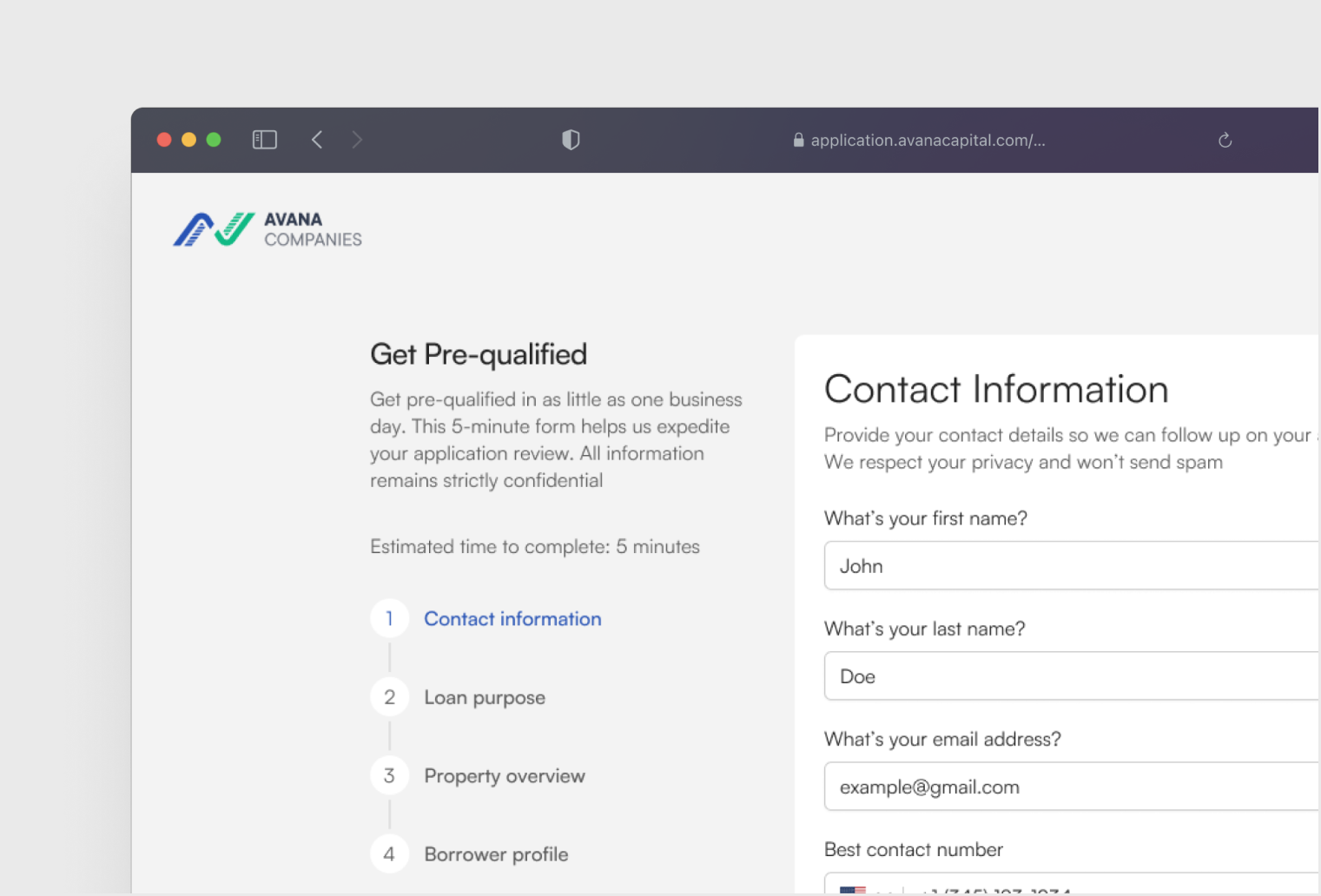
Step 2: Underwriting & Due Diligence
Underwriting is a structured review to identify key risks, determine whether they can be controlled through structure and covenants, and define a monitoring plan post-close.
- Collateral & lien position: confirm collateral support and lien enforceability, including valuation reasonableness, title/lienability readiness, and relevant third-party diligence (as applicable).
- Cash flow & coverage: analyze historical/pro forma cash flows (where relevant), DSCR-based coverage, downside sensitivities, and validation of key inputs using appropriate documentation.
- Sponsor/guarantor diligence (where applicable): review borrower/affiliate structure, relevant parties, and management capability to execute the plan.
- Market context: assess macro/local factors that could affect cash flows and execution risk—competitive set, demand/supply, and credible downside scenarios.


Step 3: Structuring & Downsizing Controls
Underwriting informs structure—where covenants and other controls help manage downside risk.
- Covenants (examples): coverage expectations, reporting requirements, performance-based mechanics (where applicable), and escrow requirements (where applicable). The objective is clarity, monitorability, and enforceability.
- Stress testing: evaluate resilience under weaker conditions (rate sensitivity and operating stress). Results inform loan sizing, covenant triggers, and monitoring priorities.
- Monitor-ability: structuring defines reporting needed to track performance and covenant compliance post-close.
Step 3: Structuring & Downsizing Controls
Underwriting informs structure—where covenants and other controls help manage downside risk.
- Covenants (examples): coverage expectations, reporting requirements, performance-based mechanics (where applicable), and escrow requirements (where applicable). The objective is clarity, monitorability, and enforceability.
- Stress testing: evaluate resilience under weaker conditions (rate sensitivity and operating stress). Results inform loan sizing, covenant triggers, and monitoring priorities.
- Monitor-ability: structuring defines reporting needed to track performance and covenant compliance post-close.

Step 4: Documentation & Closing Readiness
Final documents are completed to reflect approved terms and preserve key protections. Closing readiness may include title/escrow coordination (where applicable), insurance documentation, and deliverables supporting lien perfection and servicing readiness.
Compliance checks: closing workflows may include KYC, CDD, and other verification steps, plus final checks prior to closing.


Step 5: Decisioning & Funding
Approvals follow internal governance aligned to transaction size and risk. Where investors participate in allocations, consent may be required consistent with the structure. Funding typically occurs only after documentation, compliance, and servicing readiness are confirmed.
Step 5: Decisioning & Funding
Approvals follow internal governance aligned to transaction size and risk. Where investors participate in allocations, consent may be required consistent with the structure. Funding typically occurs only after documentation, compliance, and servicing readiness are confirmed.

Step 6: Servicing, Monitoring & Investor Reporting
Post-close oversight may include payment tracking, covenant compliance review, borrower reporting review (as required), and defined escalation pathways. Portfolio-level monitoring is reviewed on a recurring basis to identify emerging risks and understand concentrations and trends.
Investor reporting
Reporting may be delivered by email and/or online access (depending on structure) and commonly includes statements of account, applicable updates, transaction documentation (including capital call materials where applicable), and annual confirmations where applicable. Any reporting calendar is defined in investor communications and/or portal resources.

Frequently Asked Questions
Find answers to common questions
What is senior secured lending in private credit?
“Senior secured” generally refers to debt backed by collateral with priority in repayment relative to junior debt or equity—subject to the specific transaction structure and governing documents. Senior secured positioning may be paired with covenants and monitoring requirements designed to support downside risk management
What do private credit underwriters evaluate in CRE lending?
Core criteria commonly include collateral quality and lien position, cash flow coverage, borrower/sponsor capability, downside resilience under stress scenarios, and the ability to enforce and monitor covenants. Investors may also ask how reporting requirements and escalation pathways are defined post-close
What is DSCR (Debt Service Coverage Ratio) in private credit?
DSCR is a common way to evaluate whether cash flows are sufficient to cover debt payments. DSCR-based evaluation can help establish cushion and provide earlier warning when cash flows weaken. Any DSCR expectations are defined by the transaction structure and loan documents.
What is re-margining, and when can it apply?
Re-margining is a structural concept where performance changes (for example, declining NOI) may trigger requirements designed to restore agreed risk parameters—such as principal paydown or other support—depending on the loan documents.
What investor reporting is typical in private credit programs?
Reporting varies by product and structure, but investors should generally expect consistent statements, access to relevant documentation, and a defined process for inquiries and confirmations—consistent with applicable investor communications and/or portal resources.
Why do private credit managers stress test loans?
Stress testing evaluates how a loan may perform under weaker conditions (such as higher rates or weaker operations). It commonly informs loan sizing, covenant design, and post-close monitoring priorities.
Invest with AVANA
Ready to explore private credit investment options? Contact our team to discuss fit, eligibility, and next steps, or schedule a call at a time that works for you.